
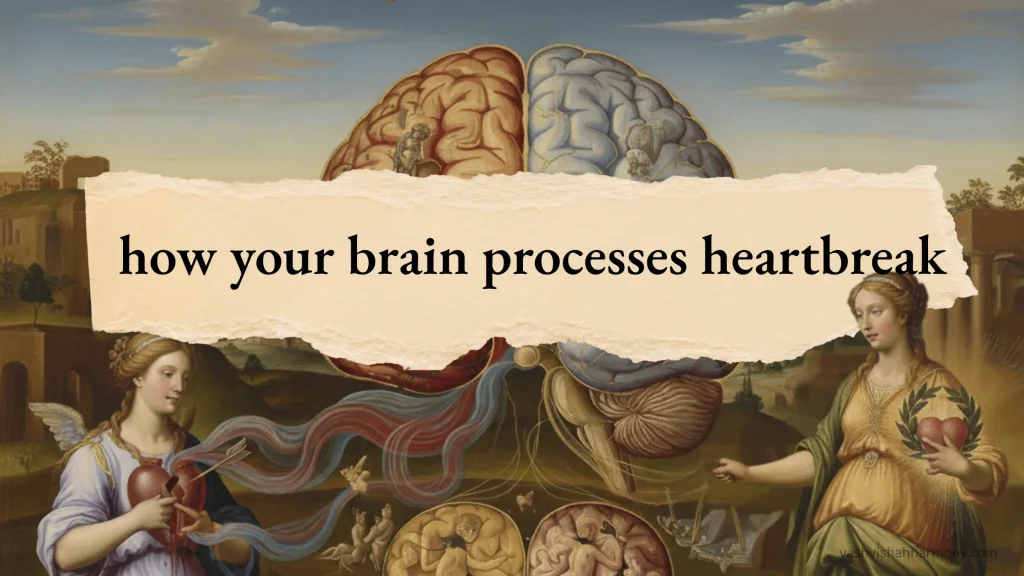
We’ve all been there. That gut-wrenching moment when someone you love walks away, when a friendship suddenly ends, or when a dream you’ve held onto for years crumbles before your eyes. You know that feeling – like someone literally reached into your chest and squeezed your heart. Well, here’s the thing: you’re not imagining it. That pain is as real as any physical injury, and science can tell us exactly why.
Your Brain Can’t Tell the Difference Between a Broken Heart and a Broken Bone
When researchers put heartbroken people into brain scanners, something fascinating happens. The same parts of your brain that light up when you stub your toe or burn your finger also activate when you’re dealing with emotional pain. We’re talking about areas like the anterior cingulate cortex and the insula – basically your brain’s pain processing centers .
So when you tell someone “it physically hurts,” you’re not being dramatic. Your brain is literally treating your heartbreak like a physical wound . That’s why you might feel nauseous, get headaches, or have that heavy feeling in your chest. Your body is responding to real pain signals.
What’s Actually Happening in Your Head
Let’s break down what your brain is going through during heartbreak, because understanding it can actually make you feel less crazy:
- The Dopamine Crash Remember how amazing it felt to be with that person? How everything seemed brighter when they texted you back? That was dopamine – your brain’s reward chemical – flooding your system. When that connection is suddenly gone, your brain goes into withdrawal mode. And yes, it’s similar to what happens with addiction . This is why you might find yourself obsessively checking their social media or replaying every conversation you had. Your brain is desperately trying to get that dopamine hit back. It’s not weakness; it’s biology .
- Stress Hormones Gone Wild Heartbreak triggers your body’s stress response big time. Cortisol – your main stress hormone – starts pumping through your system like you’re being chased by a tiger . This explains why you might feel jittery, have trouble sleeping, or keep getting sick. Your immune system is basically taking a hit because your body thinks you’re in danger.
Why Your Mind Won’t Stop Replaying Everything
You know those 3 AM moments when your brain decides to replay every single memory you have with that person? There’s a reason for this torture. Your brain is trying to make sense of what happened, and because the emotional impact was so strong, those memories got burned into your neural pathways extra deep.
It’s like your brain created a superhighway for those thoughts, making them incredibly easy to access. The more emotionally charged the memory, the stronger that pathway becomes. This is why you can remember exactly what they were wearing the day you met, but can’t remember where you put your keys five minutes ago.
Your brain is also still craving that dopamine reward, so it keeps going back to those happy memories, hoping to recreate that feeling. It’s frustrating, but it’s completely normal.
The Bigger Picture: What Loss Really Means
Here’s where things get deeper. Heartbreak isn’t just about missing someone – it shakes the very foundation of who you think you are. When you lose someone important or watch a major dream fall apart, it’s like someone took your life story and ripped out several chapters.
Philosophers and psychologists talk about how major losses force us to confront some pretty heavy questions: Who am I without this person? What’s the point of anything if this can just disappear? Am I fundamentally alone in this world? These aren’t just dramatic thoughts – they’re natural responses to having your worldview shattered.
The existentialist thinker Irvin Yalom identified four big concerns that loss brings to the surface: dealing with mortality, facing our freedom to choose, confronting our ultimate aloneness, and grappling with meaninglessness. Sounds heavy, right? But here’s the thing – working through these questions, painful as it is, can actually lead to a more authentic and fulfilling life.
When your old sense of meaning gets destroyed, you’re forced to build a new one. And often, that new foundation is stronger than what came before.
So How Long Does This Actually Take?
The question everyone wants answered: when will I feel normal again? Research gives us some rough timelines. Market research suggests about 3.5 months for a typical breakup, while divorce recovery can take 1.5 years or longer. Studies on college students found most felt significantly better after 10-11 weeks.
But here’s the crucial part – these are just averages. Your timeline might be completely different, and that’s okay. The depth of your attachment, your personality, your support system, and how you cope all play a role in your recovery speed.
If you feel like you’re “dwelling” longer than you should, don’t beat yourself up. Sometimes the people who take longer to heal are simply those who loved more deeply or are doing the harder work of rebuilding their sense of meaning.
Taking Back Control
While you can’t fast-forward through the pain, you’re not completely powerless. Understanding that your brain is in a temporary altered state can help you be more patient with yourself. You’re not broken; you’re healing.
Here’s the interesting part: while everyone’s brain processes heartbreak pain in fundamentally the same way, how you respond to that pain can make all the difference in your recovery. Two people can experience identical neurological responses – the same dopamine crash, the same stress hormone surge, the same painful brain activity – but one might bounce back in weeks while the other takes months or even years.
What makes the difference?
How you choose to react
Recovery is an active process, and your brain needs new experiences to create new neural pathways. This might mean trying things you’ve never done before, reconnecting with old friends, or pursuing interests you put on the back burner. You’re literally rewiring your brain to function without that constant dopamine hit you used to get.
Some people dive headfirst into new activities and social connections. Others might prefer quiet reflection and gradual re-engagement with the world. Some find healing through creative expression, while others need physical movement or intellectual challenges. The key is finding what works for your particular way of processing and moving through pain.
Building new connections and finding fresh sources of meaning aren’t just feel-good advice – they’re neurologically necessary for healing. Each new positive experience helps your brain remember that joy is still possible. But the path to those experiences? That’s entirely up to you, and it might look completely different from someone else’s journey.
The Road Forward
Heartbreak feels like the end of the world because, in many ways, it is the end of your world as you knew it. But here’s what the science tells us: your brain is incredibly adaptable. Those same neural pathways that are causing you so much pain right now can be rewired. That same capacity for deep attachment that made the loss so devastating is also your capacity for future connection and meaning.
The pain you’re feeling isn’t a sign that something’s wrong with you – it’s proof of your capacity to love deeply. And while that might not make it hurt any less right now, it’s a reminder that you have the emotional depth to build something beautiful again, even if it looks different than what you had before.
Healing doesn’t mean forgetting or going back to who you were. It means integrating this experience into a new, more complete version of yourself. And while that journey is anything but easy, understanding the science behind what you’re experiencing can help you navigate it with a little more compassion for yourself and a lot more hope for what’s ahead.
Sometimes, the most profound truths about healing and resilience come not just from science, but from the quiet wisdom of poetry and reflection. In moments of pain, we often find solace in simple rituals – like taking a long, hot shower that seems to wash away more than just the day’s troubles.
The storm has gone,
The sun will rise.
You came this far,
You are surely wise.
Though clouds may linger
Around for sometime.
Know, there’s a long while
Before another storm arrives.
-Harmony
From “The North Star”
If these words resonated with you, you’ll find more poetry about healing, growth, and finding your way through life’s storms in The North Star – a collection of verses that speak to the journey through Realize, Accept, and Cherish.